[ TOURNAMENT STRATEGY ]
How Payout Structure Changes Pay Lake Carp Tournament Strategy
The payout does more than decide who gets paid. It changes what fish matters, how much the clock matters, what the board is telling you, and what job your rods should be doing.
How Does Payout Structure Change Tournament Strategy?
Pay lake carp tournament payout strategy dictates that you do not fish for every carp in the pond; you fish specifically for the carp that win the live pots you entered. The money structure changes your strategy by forcing you to allocate your rods based on the clock, the target weight, the required fish class, and the current board leader, rather than just blindly casting for a bite.
Need the payout terms first? Start with How Pay Lake Carp Tournament Payouts Work for Hourly, Every 20, Big on End, Jugs, Floaters, Spots, Fish Offs and All-In terminology.
The Program Defines the Objective
Most amateurs walk to their peg, mix up their favorite packbait, cast out all their rods, and sit down. They start with the bait. That is the fastest way to donate your entry fee to the regulars.
Before you ask what bait to throw, you must define the objective. The tournament program dictates the value of the fish. A 14.9-pound carp might be the most valuable fish on the property if it locks up a 15.0 lb Jug, but that exact same fish is mathematically useless if your Top-5 cut fish is sitting at 16 pounds.
If you don't map your rods to the live money, you can end up burning rod-time on an opportunity that does not pay you.
The Payout-to-Strategy Matrix
How you manage your peg changes violently depending on the format. Here is how the money dictates the mission.
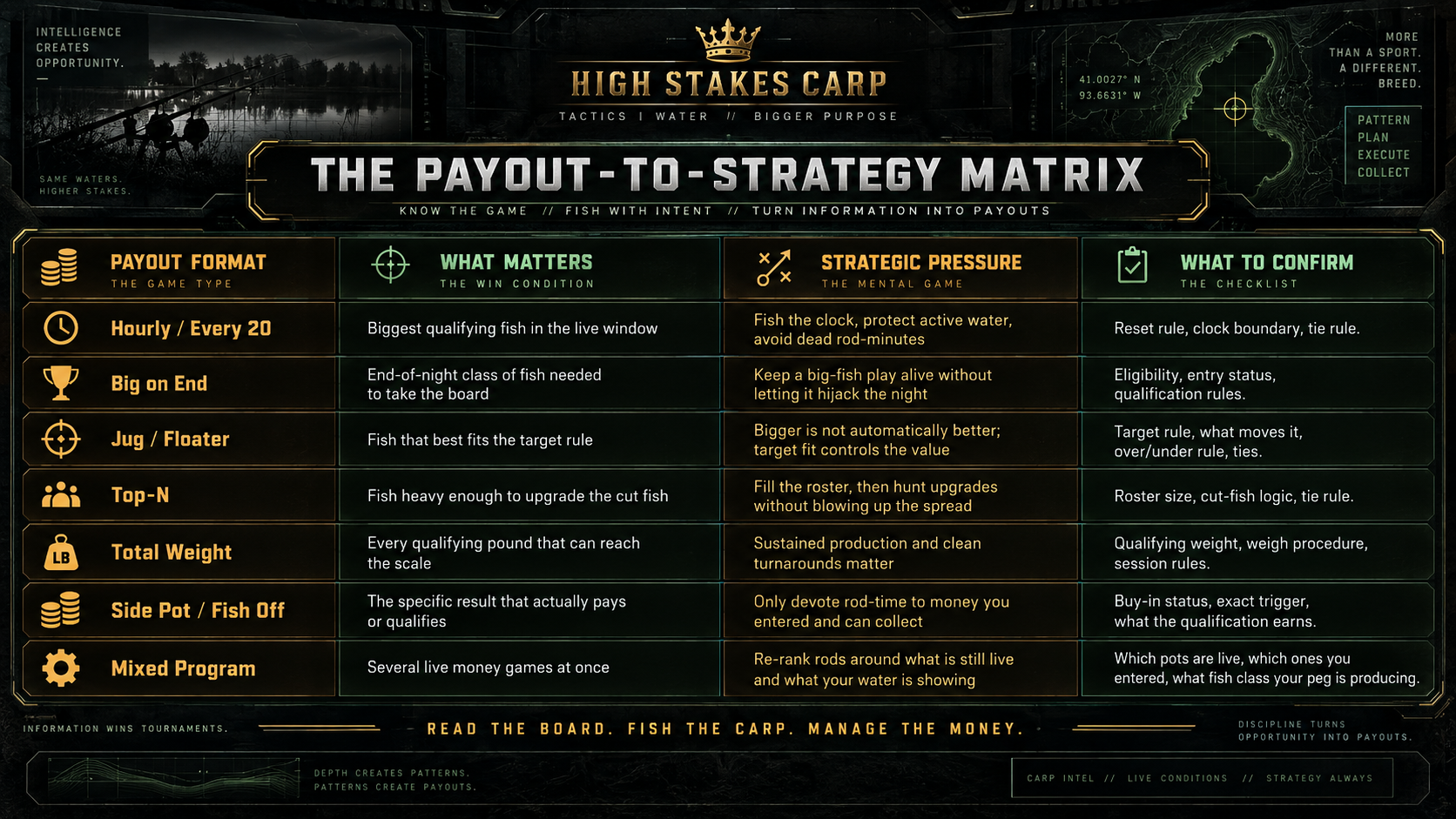
Payout Format
Strategic Priority
What Kills You (The Mistake)
Hourly / Every 20
Strategic PriorityFast turnarounds, protecting working lanes, sprinting to the buzzer.
What Kills YouHaving rods out of the water being rebaited when a hot window is closing.
Big on End
Strategic PriorityDedicating a specific rod to hunt a heavier fish class without destroying your hourly volume.
What Kills YouThe “Big-Check Trance”—burning all your rod-time on a monster that your water doesn't hold.
Jugs & Floaters
Strategic PriorityMatching the required target weight to the fish class your peg is currently producing.
What Kills YouChasing a 15.0 lb Jug target when your peg is only holding 10 lb fish.
Top-N (Top 3 / 5)
Strategic PriorityFilling the roster fast, then ruthlessly hunting upgrades to beat your weakest cut fish.
What Kills YouWasting time catching 12-pounders when your cut fish is 15 pounds.
Total Weight
Strategic PriorityMaximum volume, sustained qualifying production, and aggressive hook-to-net speed.
What Kills YouSitting back waiting for one big bite while the pond grinds out heavy volume.
Side Pots / Fish Off
Strategic PriorityEnsuring the rod is chasing money you actually bought into or tickets you need.
What Kills YouFishing a side-pot strategy for a pot you skipped at the entry window.
Hourly / Every 20 — Fish the Window, Not the Whole Night
Hourly carp tournament strategy (or "Every 20" strategy) requires you to stop looking at the night as one long, eight-hour session. You are fighting a series of brutal, miniature tournaments stacked back-to-back.
When the board resets, the previous leader is dead. You need to keep your working rods locked in and avoid needless downtime. If a rod is sitting on the bank being re-tied for five minutes during a 20-minute payout window, you just burned 25% of your opportunity for that rod to get paid. Fish the sprint. Protect what is working, and use the resets to clear your head.
Big on End — Keep a Big-Fish Play Alive Without Letting It Hijack the Night
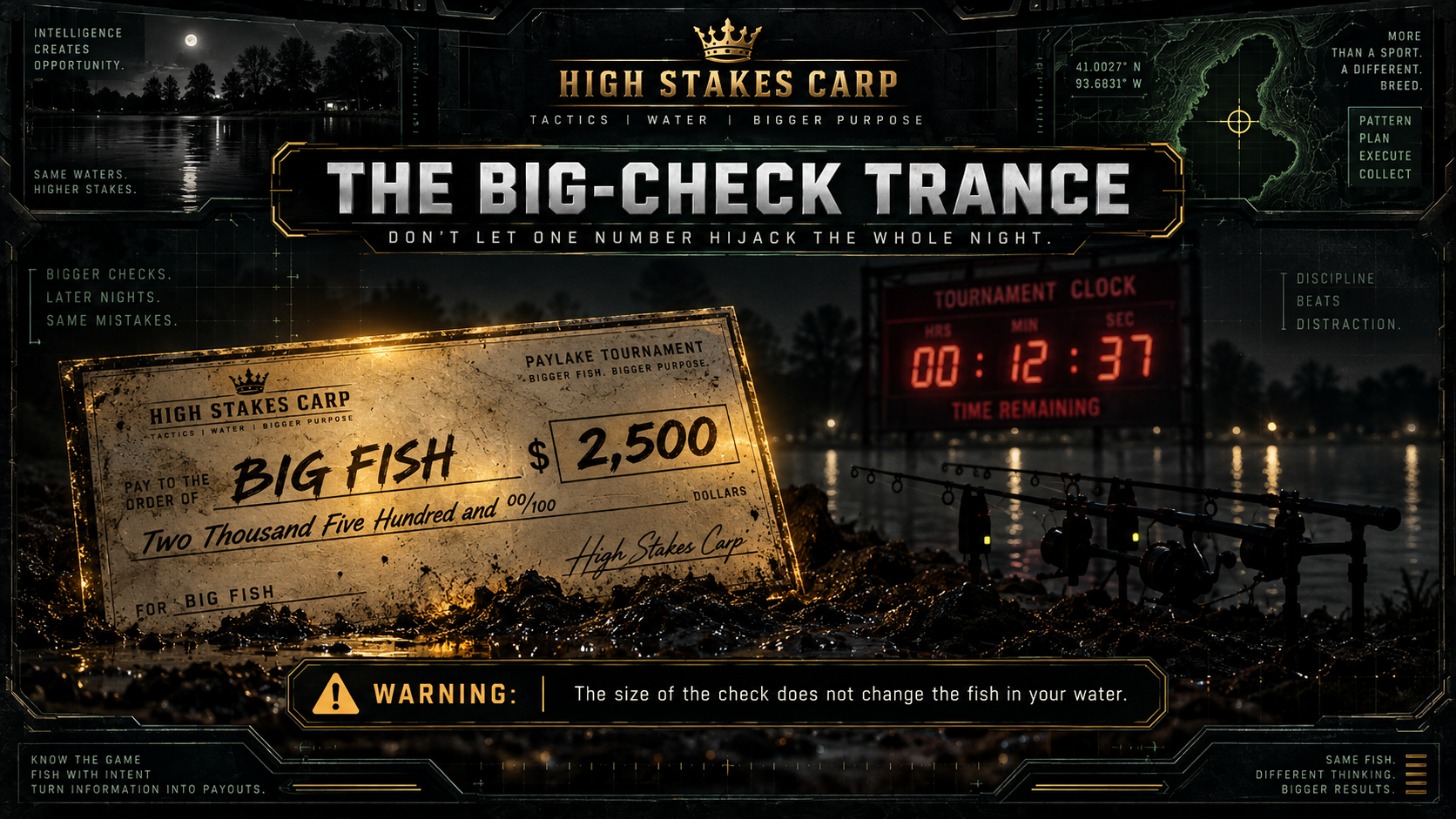
Big on End strategy is where egos destroy bankrolls. When the Big on End number is the check that jumps off the flyer, it can put an angler into the Big-Check Trance. Suddenly every rod starts hunting a giant the water has never shown, while live money keeps moving on the rest of the board.
You must keep a big-fish play alive without letting it hijack the night. The size of the check does not magically force your water to produce a 30-pound carp. You have to balance the cost: dedicate a specific rod to hunt the upgrade, but let your main rods pay the hourly bills.
Jugs & Floaters — Bigger Is Not Automatically Better
In target-weight money, bigger is not automatically better. The fish that fits the target rule is the fish that matters. Depending on the program, that may mean closest, closest without going over, an exact match, or another defined relationship to the number. Jug carp tournament strategy requires incredible discipline.
If a 15.0 lb target is on the board, and the current leader is 14.8 lbs, the window has compressed. You are now threading a needle. If the carp in your water are consistently weighing 11 to 12 pounds, do not keep a rod parked on the Jug just because the pot is open. Let the carp in your water tell you whether that opportunity still deserves your attention. The same applies to Floater strategy: when the target shifts, your rod jobs must shift with it.
Top-N — Once the Roster Is Full, You Need Upgrades
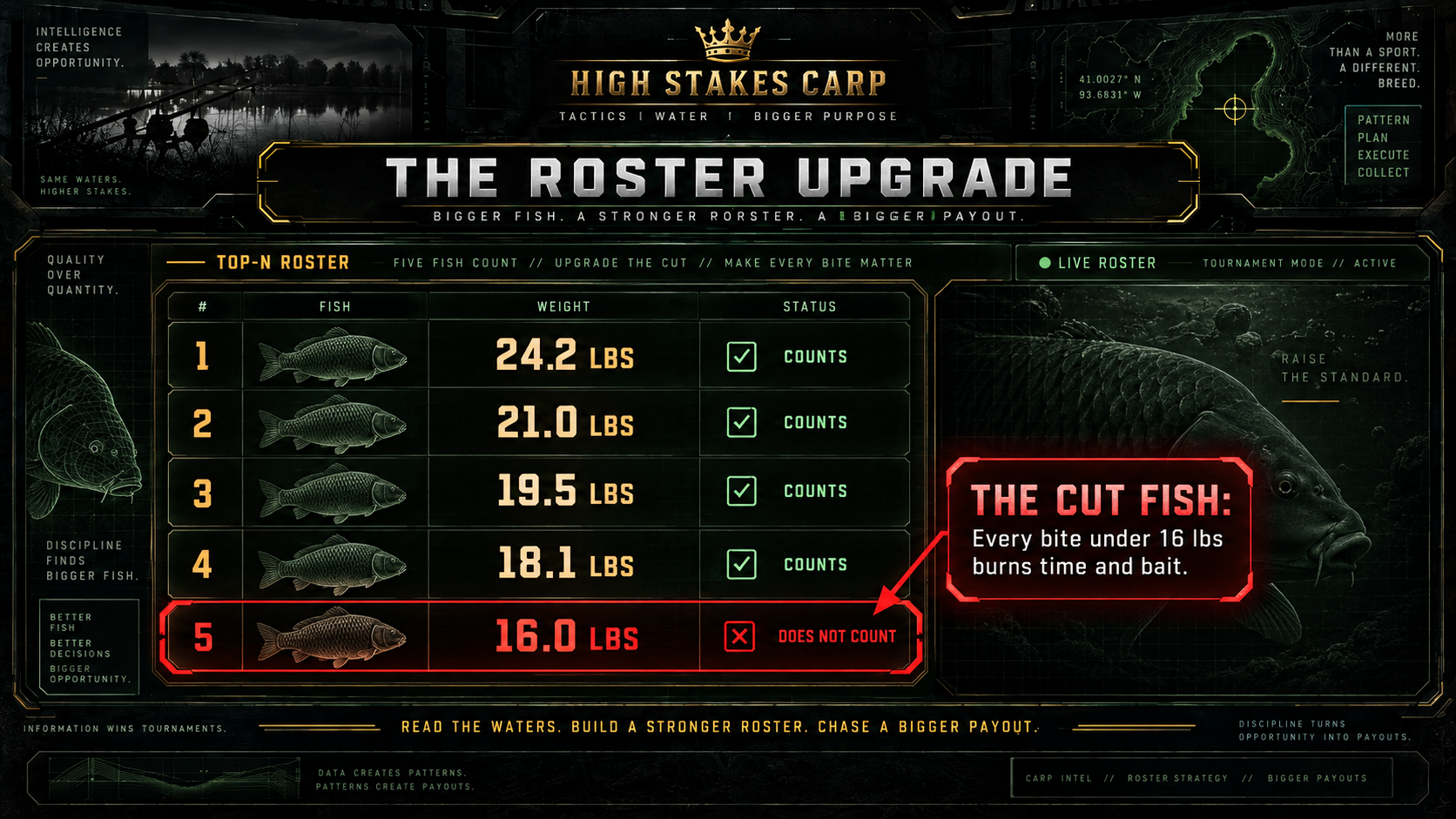
Top-N carp tournament strategy (like Top 3 or Top 5) is a game of ruthless upgrades. Your first priority is putting fish on the board to fill the roster. Once that list is full, your strategy must pivot.
Look at your weakest scoring fish. That is your "cut fish." If your cut fish is 16 pounds, another 15-pounder does not improve that Top-N score. It may still matter somewhere else on a loaded board, but it does not upgrade the roster. Every fish under 16 pounds is a wasted bite that burns time and bait. You must adjust your distance, depth, or presentation to actively filter out the small fish and hunt the upgrade.
Total Weight — Production Changes the Job
Total-weight carp tournament strategy is a muddy, physical grind. There is no cut fish and no target window. Every qualifying pound matters.
Production changes the job here. You need an aggressive feeding lane, flawless fish handling, and rapid turnarounds. You cannot afford to play games with experimental bait flavors if the pond is actively feeding. You find the working lane, you lock it down, and you keep your lines wet.
Side Pots, Porch & Fish Off — Only Fish Money You Can Actually Collect
Side-pot strategy and Fish Off strategy come down to one brutal rule: only fish the money you can actually collect.
If you skipped the optional side pot at the window to save $20, erase it from your mind. Do not pull a rod off a working hourly lane to chase a target you aren't even entered in. Conversely, a Fish Off ticket can create massive value beyond tonight's immediate check. If winning a specific hour secures your ticket to a $10,000 championship, that specific hour requires your most aggressive, high-percentage tactics.
Loaded Programs — One Night Can Be Several Games at Once
Many American paylake programs layer more than one money format into the same night. Pay lake tournament strategy gets complicated because a single night can be several games at once.
Look at these anonymized, modeled examples drawn from current, real-world paylake structures in the Southeast:
The Layered Sprint: $100 Every 20 Minutes, plus Floater Jugs, and an optional 5-Biggest format running simultaneously.
The Heavy Stack: A Derby format layered with half-session pots, a massive Big on End check, All-In pricing, and a Fish Off qualification on the line.
These are modeled examples drawn from documented paylake program structures. They are not universal rules or representations of one specific pond. Always confirm the current program before you fish.
In a loaded program, you cannot fish one generic "tournament setup." You might need one rod hunting the hourly cash, one rod protecting the Top-5 roster, and one rod probing the perimeter for the Big on End monster.
The Board and Clock Are Information. The Crowd Is Noise.
Carp tournament board strategy means making decisions based on data, not anxiety.
When a 22-pounder hits the board, the board just gave you a mathematical fact. When the guy three pegs down starts bragging about a secret strawberry flavor, that is noise. Do not change your rods because the crowd looks busy. Read the board, watch the clock, and let the carp dictate your next move.
When the Money Changes, Re-Rank the Plan
The tournament that made sense at 7:00 PM is not the same tournament you are fishing at 1:00 AM.
As the night bleeds out, windows expire, targets move, and the fish class in your peg may shift. Carp tournament clock strategy requires you to constantly re-rank your plan. As the night changes, re-rank the money by what is still live, what the board now requires, how much time remains, and what fish class your water has actually shown. Do not move a rod because a pot looks tempting. Move it because the carp have given you evidence that another job now deserves the rod.
Common Payout-Strategy Mistakes
If you want to protect your bankroll, stop making these unforced errors:
Fishing dead money: Chasing a pot you didn't buy into or a timed window that has already closed.
The panic pivot: Changing every rod in your spread just because someone on the far bank caught one good fish.
Confusing the biggest fish with the money fish: Blowing up a working setup to hunt a 30-pounder when heavy 15-pound volume is paying the hourly bills.
Copying the bank: Mimicking your neighbor's distance and bait instead of reading the specific contours and fish class holding in your own water.
[ FAQ ]
Frequently Asked Questions
How does the clock affect carp tournament strategy?
The clock dictates urgency. In a timed format (like Every 20), a rod out of the water is bleeding money. Your strategy must focus on fast turnarounds and protecting working lanes before the buzzer wipes the board clean.
Should I buy into every side pot at a pay lake?
Not necessarily. You should only buy into optional pots if your bankroll supports it and you have a deliberate strategic plan to assign a rod to hunt that specific target.
What is the best strategy for a Top 5 carp tournament?
Fill your five-fish roster as quickly as possible with baseline catches. Once full, identify your lightest fish—the cut fish—and start changing variables deliberately. This is where the 4-Rod Tournament System™ earns its place: it gives you a controlled system for testing bait, pickup, presentation, distance, or depth without blowing up the entire spread. Let each rod do its job. Protect the working setup, use the other rods to test specific changes, and let the carp tell you which variable deserves to stay. From that point forward, the Top-5 objective is simple: catch a fish heavy enough to replace the cut fish.
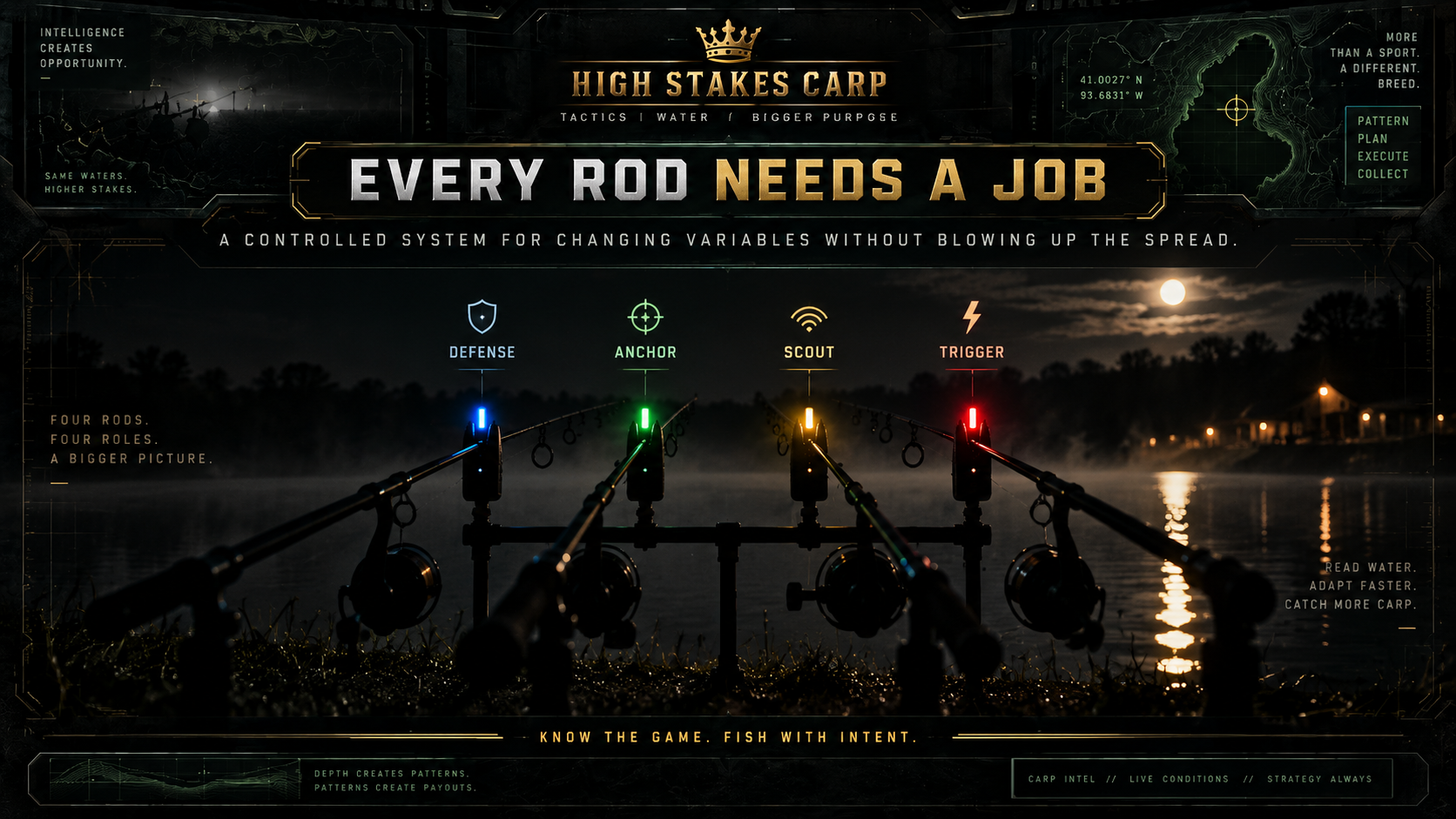 See the 4-Rod Tournament System™ → $47
[ GO DEEPER ]
Go Deeper: Know What Pays Tonight™
Understanding why the money changes your strategy is exactly how you separate yourself from the amateurs on the bank. But knowing the theory won't tell you exactly when to move your rods at 2:00 AM.
How do you calculate the exact mathematical cost of chasing a big fish? How do you set up your peg so one rod tests a new bait without destroying your main cash-producing lane?
If you want the complete, proprietary operating system for American paylake tournament fishing, you need the tactical playbook.
Learn the game. Understand the money. Fish against the carp.
Get the Know What Pays Tonight™ Playbook - $47