[ TOURNAMENT PAYOUTS ]
How Pay Lake Carp Tournament Payouts Work
A plain-English guide to Hourly Money, Every 20, Big on End, Jugs, Floaters, Side Pots, Spots, Top-N, Fish Offs, All-In Costs and Local Payout Rules.
How Do Pay Lake Carp Tournament Payouts Work?
Pay lake carp tournament payouts are determined by the specific program being run that night. A tournament may pay for the biggest fish during timed periods, the biggest fish at the end of the event, fish closest to a target weight, the combined weight of several fish, optional side pots, qualification opportunities, or several of these structures at the same time. Exact rules vary by pond and event.
What Actually Pays Tonight?
A pay lake carp tournament can have several different money games running on the same water at the same time.
One carp may matter to an hourly board. Another may matter to Big on End. A fish close to a target weight may matter to a Jug or Floater. A perfectly good carp may mean nothing to a Top-5 score if it does not beat the cut fish.
If you are mixing your bait before you understand the payout board, you are already donating your entry fee to the guys who do. That is why the first question is not: What bait should I use? The first question is: What actually pays tonight?
American paylake terminology varies by pond and operator. The same familiar word can even be used differently from one program to another. This guide explains the major payout structures and the questions an angler should ask before the first cast.
The pond's rules always win. Confirm the program being used tonight.
[ THE DICTIONARY ]
The Master Pay Lake Payout Dictionary
Before you uncase a single rod or launch an ounce of packbait, you must understand the local language. Guessing at the window is the fastest way to bleed your bankroll.
Term
What it usually means
What the angler must confirm
Hourly / Every 20
What it usually meansA timed payout window
ConfirmReset time, boundary/scale rule, tie rule
Big on End
What it usually meansEnd-of-session big-fish money
ConfirmWhether included, payout, final qualification rule
Jug
What it usually meansTarget-weight money
ConfirmExact target, over/under rule, ties
Floater
What it usually meansA target that can change under the program
ConfirmWhat moves it and when
Side Pot / Pot
What it usually meansAdditional money operating beside the main event
ConfirmEntry cost, qualifying fish, payout method, places paid
Derby
What it usually meansA local tournament or time-block money format
ConfirmEntry structure, what pays, scoring method, whether periods reset
Top 3 / Top 5
What it usually meansBest-N scoring
ConfirmFish count, replacement/cut rule
Total Weight
What it usually meansCombined qualifying weight
ConfirmQualification and weigh rules
Spots / Places
What it usually meansPaid positions or another program-specific unit
ConfirmWhat "spot" means tonight, number of positions paid, scoring method
Fish Off
What it usually meansQualification into another event or stage
ConfirmHow qualification is earned
All-In
What it usually meansUsually the full set of available entries/pots
ConfirmExactly what the quoted amount includes
Five Questions to Ask Before You Pay
Base Entry vs. Optional Money
Understanding the money structure at the entry window is your first line of defense.
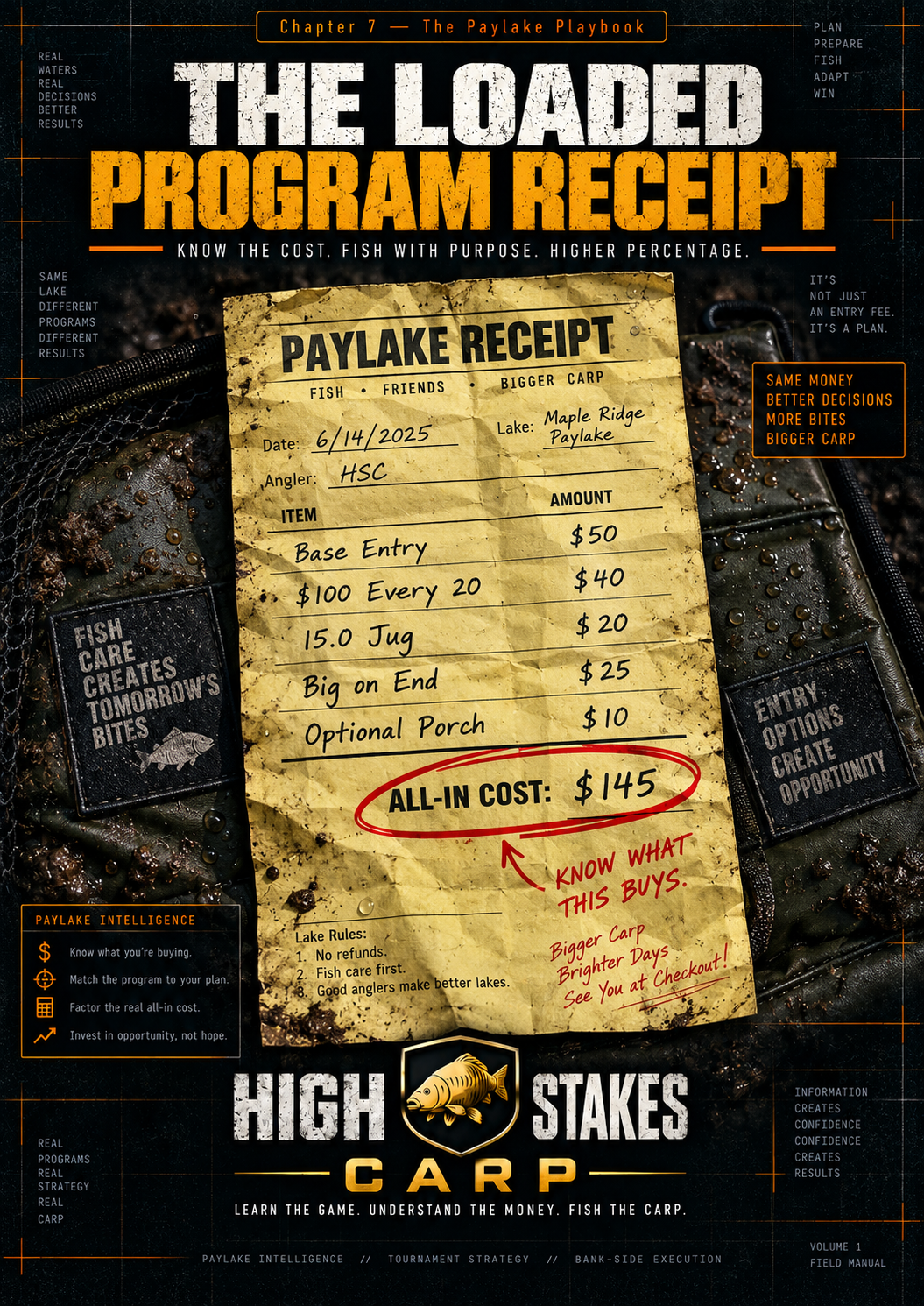
Base Entry / Set: Covers whatever tournament components the operator lists as included in the base price. Never assume hourly money, Big on End, jugs, spots, or another payout is included—confirm the program.
Optional Money: Some side pots, jugs, floaters, biggest-fish pools, or other program components may require an additional buy-in. Which parts are included and which are optional varies by event.
The "All-In" Quote: Operators will quote an all-in price, but you must explicitly ask what that covers.
Hourly & Timed Money
Timed payouts—often described as Hourly, Every 20, or another defined period—are one of the established formats used in American paylake tournaments.
The Mechanic: The pond establishes a defined payout period. In many timed big-fish formats, the biggest qualifying fish for that period takes the money, but the exact scoring and qualification rule belongs to the event.
The Reset: When one payout period closes, that period is settled under the pond's rule and the next money window begins.
What to confirm at the window: Ask exactly what must happen before the payout period closes for the fish to count—hooked, landed, presented at the scale, weighed, or another event-specific requirement.

Derby Money
Derby formats are frequently layered into or around the main event. Because Derby rules are heavily localized, ask exactly what it pays, how it is scored, and whether the periods reset.
Jugs & Floaters
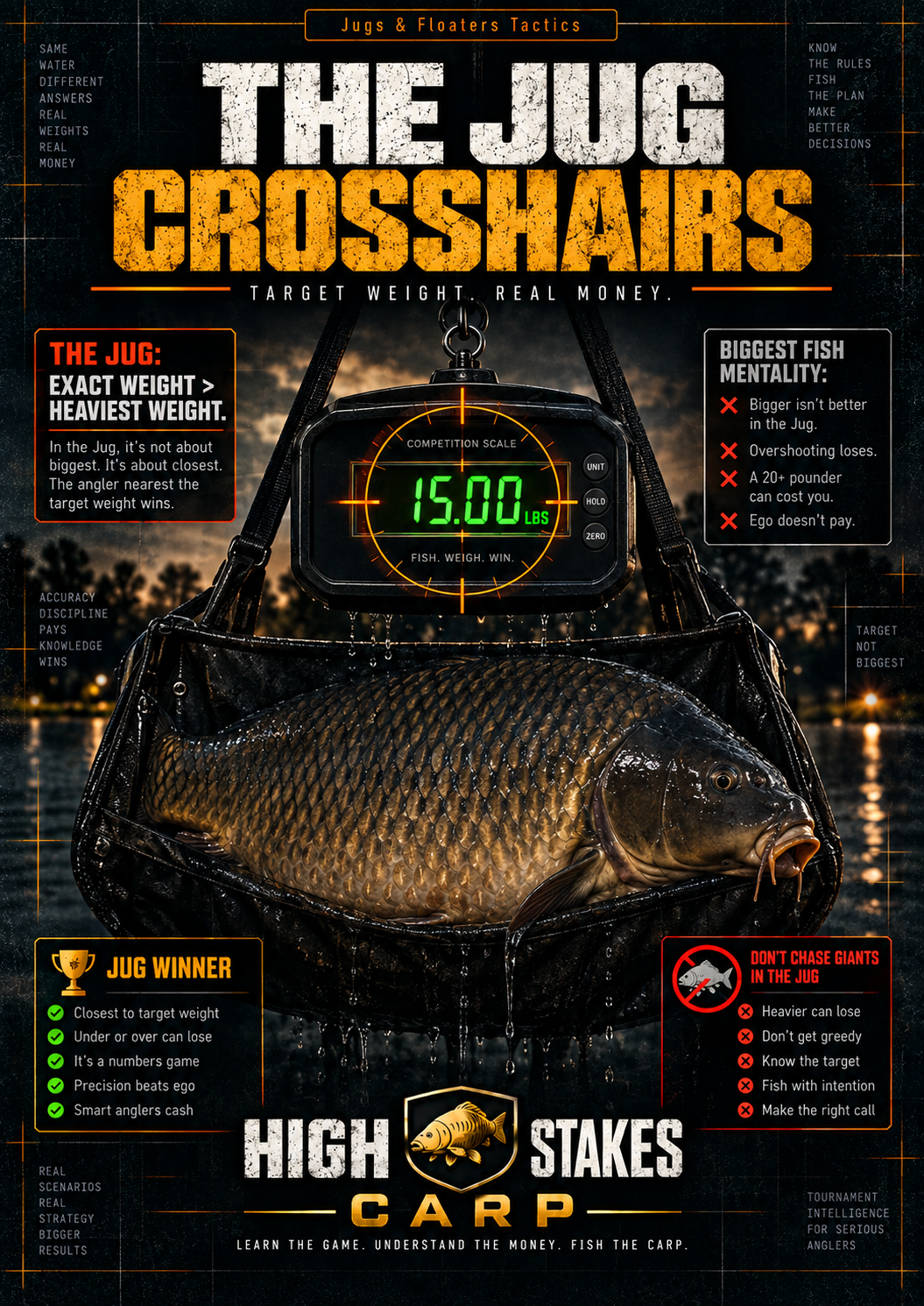
Target pots change the math of a tournament. The heaviest fish on the property may mean nothing to that target pot if it does not fit the required number under the local rule.
The Jug: Target-weight money built around a stated number. Depending on the local rule, the winning fish may be the closest fish, closest without going over, an exact match, or another defined relationship to the target.
The Floater: A target that can change during the night based on the pond's specific program rules.
What to confirm at the window: Ask exactly what event moves the Floater and what the tie-breaker rule is if two anglers hit the exact same weight margin.
Big on End
Big on End usually refers to end-of-session big-fish money, commonly built around the heaviest qualifying fish under that event's rules.
The Mechanic: Unlike hourly pots that wipe clean, the Big on End board stays alive from the starting siren to the final horn.
The Reality: Big on End usually carries the giant check that blinds beginners. Because that payout looks so good on the flyer, it is incredibly easy for an angler to get hypnotized and give the end-of-night chase more rod-time than the water has actually justified.
What to confirm at the window: Ask whether Big on End has any separate eligibility, qualification, weigh-in, or entry requirement. Never assume the end-money rules match the hourly rules.
Top-N Scoring: Top 3, Top 5 & Best-N Formats
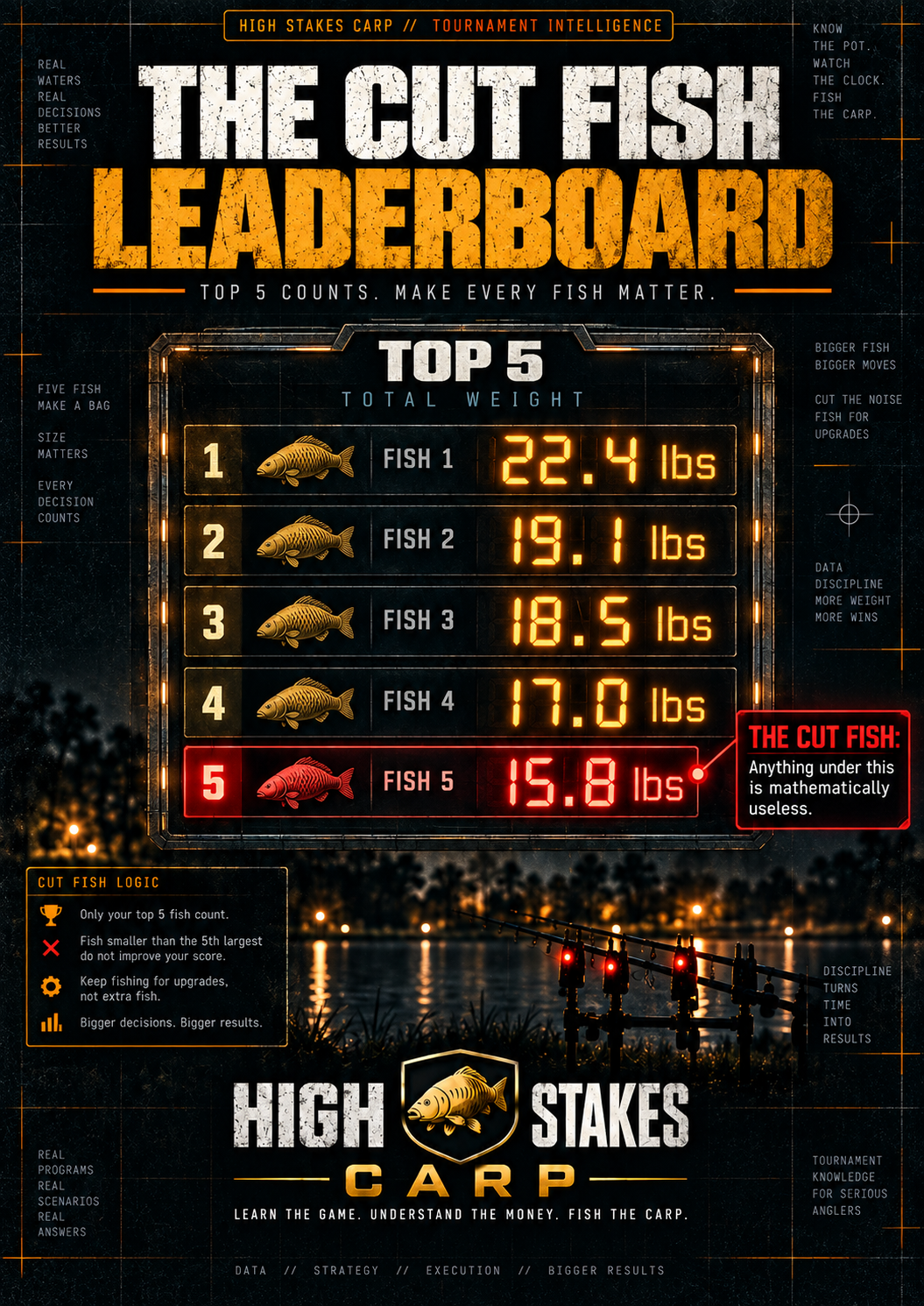
Top-N formats score a defined number of fish rather than every fish caught. Depending on the program, Top 3 or Top 5 may mean the combined weight of an angler's best three or five qualifying fish. Always confirm the scoring rule.
The Cut Fish: Once your roster is full, the game changes. If you have five fish on the board and your smallest is 15.8 lbs, that is your "cut fish." From that moment on, a 14-pounder might fight hard and look great in the net, but it is mathematically useless to your score.
Spots & Places
"Spots" and "Places" are local tournament terms that can refer to paid finishing positions, fishing positions, or another program-specific unit. You cannot take a rigid set of assumptions into a new peg. Do not assume the meaning from another pond. Ask exactly what the spots are, how they are earned, and how many pay.
Total Weight
While Top-N forces you to upgrade your catches, Total Weight is a pure volume format.
The Mechanic: Every qualifying pound you put in the net adds to your cumulative score on the scale.
The Reality: Total-weight formats are a pure, muddy grind. They reward sustained, aggressive qualifying production across the entire session rather than sitting back and praying for one standout monster.
What to confirm at the window: Ask which fish qualify for the total, whether a minimum qualifying weight applies, how weigh-ins are handled, and whether every qualifying fish contributes to the final score.
Side Pots & Porch Money: The Layered Game
Many tournaments layer additional money pools on top of the main event.
The Mechanic: A side pot is additional money operating beside the main event and may require a separate buy-in. Confirm whether it is included or optional and exactly what result pays it.
Porch / Porch Pot: A regional paylake money term that may refer to optional side action or another locally defined payout. Exact usage varies, so ask what "Porch" means at that pond tonight.
What to confirm at the window: Ask exactly how much the buy-in is, what specific metric wins it, and how many places it pays.
Fish Offs: Qualification Money
Sometimes, the carp you catch tonight doesn't just win you cash—it wins you a seat at a much bigger table.
The Mechanic: A "Fish Off" is a progression format. Catching a qualifying fish (or winning a specific period) earns you a ticket into a later, higher-stakes event.
The Reality: A Fish Off opportunity can give a qualifying fish value beyond the immediate night's cash payouts. Whether that should change your strategy depends on exactly what qualifies and what the qualification earns.
What to confirm at the window: Ask what the qualification actually provides—entry, eligibility, a reserved position, or another event-specific benefit.
What Current Paylake Programs Can Look Like
Current documented paylake programs show why definitions alone are not enough. One event may combine Best-N scoring, Floater Jugs and optional side money. Another may run timed big-fish payouts alongside target-weight money and an optional multi-fish pot. A different program may layer Derby money, half-session payouts, Big on End, all-in pricing and Fish Off qualification into the same night.
These are modeled examples drawn from real program structures. They are not universal rules. Always verify the current event directly with the operator before you fish.
Why We Say the Language Varies
American paylake language is brutally local. Current public American paylake programs—especially in the Southeast—show combinations of timed money, floaters, biggest-fish formats, Derbies, optional pots, all-in pricing, Jugs, Top-N formats and Fish Off qualification.
You cannot drag a rigid set of assumptions into a new peg and expect to walk away with the money.
Research Note: High Stakes Carp reviews public tournament schedules, operator information, historical tournament material, and current American paylake program language. Public examples are anonymized unless a pond is intentionally featured. Program rules change. Always verify the current event directly with the operator.
Now Turn the Payout Into a Strategy
Knowing what Hourly, Every 20, Big on End, Jugs, Floaters, Spots and Side Pots mean is step one. The next question is what those payout structures should change about the way you fish the board, the clock and the carp in your water.
Read the Pay Lake Carp Tournament Payout Strategy Guide →[ FAQ ]
Frequently Asked Questions
What does Every 20 mean in a pay lake carp tournament?
“Every 20” usually refers to a 20-minute payout period. In many programs, the biggest qualifying fish for that period takes the money, but the exact scoring, reset, and clock-boundary rules belong to the event.
What does Big on End mean?
Big on End is the payout awarded at the very conclusion of the tournament for the single heaviest qualifying fish caught during the entire session.
What is a Jug in paylake carp fishing?
A Jug is a target-weight payout. Instead of paying for the heaviest fish, the pond pays for the fish that most closely matches a predetermined target weight (like 15.0 lbs), depending on the pond's specific over/under rules.
What is a Floater?
A Floater is target-weight money in which the target can change under the event's rules. Ask what moves the target, when it changes, and how ties or over/under relationships are handled.
What does All-In mean?
All-In is the total combined price to enter the base tournament and all optional side pots, jugs, and extra payouts. Always ask the operator exactly what the All-In fee covers.
What is a Fish Off?
A Fish Off is a qualification format. Catching a specific fish or winning a certain pot earns the angler an invitation, eligibility, or paid entry into a future, higher-stakes championship tournament.
What are Spots in a carp tournament?
Spots can mean paid finishing places (e.g., paying out to the top 3 spots), or it can refer to the physical fishing positions around the lake. The exact meaning depends on the local program.
Are pay lake tournament rules the same at every pond?
No. Pay lake language and rules are highly localized. The same term can mean two different things at two different ponds, and a single pond can change its program from Friday to Saturday.
[ GO DEEPER ]
Know What Pays Tonight™
Knowing the definition of a tournament term proves you understand the rules. But knowing the rules will not put a fish in your net.
If you want to stop walking in blind, Know What Pays Tonight™ takes the next step: turning the program, board, clock, fish class and available water into a structured bank-side decision system.
The free guide explains the money. The playbook teaches you how to run the night.
Get the Know What Pays Tonight™ PlaybookTournament Entry ROI Calculator
Calculate entry costs and risk before entering.
Peg Draw Risk Score Tool™
Score your peg before building your payout plan.
Bait Breakdown & Recast Timer
Decide when to hold and when to reset.
The 4-Rod Tournament System™
Build a complete tournament rod setup.
Pay Lake Carp Tournament Glossary
Understand payout terminology.